Key guiding principles of a reward strategy:
Competitive but affordable
- Reward policy not to be driven by competitive market trends and movements, but it should be informed by them.
- Reward to be pitched at a level that enables each part of the business to attract, engage and retain the required talent.
- Systematic benchmarking of total reward against the right market comparators.
Pay for Performance
- Reward arrangements to recognize high performance - it should differentiate between high performance, average and substandard performance.
- Reward to be linked to agreed measures of business and individual performance.
- A meaningful proportion of reward at Senior level should be ‘at risk’.
Simple and Transparent
- Develop simple and transparent systems with a significant amount of clarity on how they work and minimize ‘discretion’.
- Invest significant time in the communication of reward ensuring it is clear, user friendly and in plain language.
- Managers should be able to manage the day-to-day aspects of reward, including questions from their employees.
Fair & Trustworthy
- Reward arrangements should ensure fairness of treatment within and between employee groups.
- Employees will trust the way they are rewarded and that outcomes for variable pay are linked to the actual performance delivered.
Consistent & Sustainable
- New reward arrangements should stand the test of time and not be required to be subject to regular re-designs (only evolutionary revisions).
- Reward arrangements should be flexible to the changing business needs, including the mobility of talent to meet project requirements.
Clear levels of governance
- Reward recommendations should be made by managers and senior executives who have the right oversight on business requirements and performance.
- Sign-off for reward outcomes should be delegated but taken by sufficiently independent individuals to promote good governance.
Objectives of a reward strategy:
A reward strategy addresses the “why”, “how”, and “how much” questions surrounding pay and incentives.
The objectives of a reward strategy are to address the following:
- Set out principles to guide the design, development and implementation of a reward program
- Support the attraction, retention and engagement of the talent required to deliver the business strategy
- Reinforce the desired organization culture and desired behaviors amongst employees
- Provide the basis for sound reward governance
- Provide the basis for communication with staff
What are the strategic issues in reward?
- Represents an investment in the most valuable asset in the organization: Human Resources
- Is often the biggest recurring annual cost
- Provides an excellent mechanism for aligning organizational goals with employee goals
- Provides major communication to employees about what the organizational values are and their progress in the organization
- Major leverage on employee behavior
A clearly articulated Reward Strategy will help the organization align employee behaviors and actions to the business strategy, attract and retain key talent.
Reward strategy can be achieved through:
- Strong internal equity based on effective job evaluation;
- Proper market alignment through effective comparison and positioning against reliable external market data on pay and benefits;
- Structuring the “package” to get the right balance between, basic salary, bonus, allowances, and benefits; AND
- Developing an effective link between remuneration and job performance.
Policy setting and costing ‘Best Practice’ approach:
- Determine the relevant markets for comparison
- Establish the desired ‘market position’
- Compare your data to the market
- Calculate and test alternatives
- Select the ‘best’ alternative
Positioning against the market depends on:
- Competitive practice
- Affordability
- Business economics
- Culture
What is Total Reward?
In an extremely competitive marketplace for talent, most companies are focusing on incentives and intrinsic elements to motivate and improve retention. Any arrangement must be looked at within the context of the company philosophy on ‘Total Reward’.
Total Reward Elements
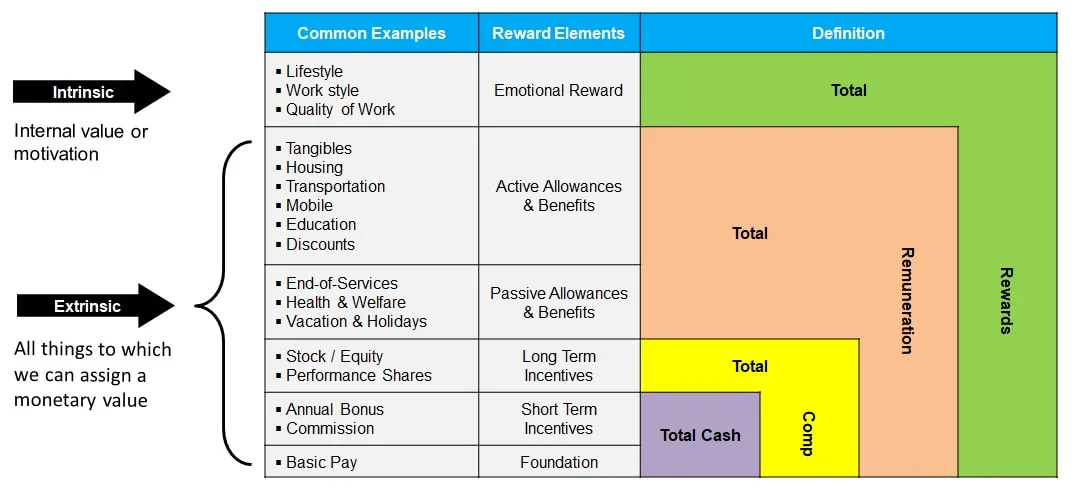
How is the pay changing?
- Business oriented “New Pay” is a way of aligning & optimizing performance.
- Administration oriented “Traditional Pay” is a way of controlling employment costs.
Traditional Pay vs. New Pay
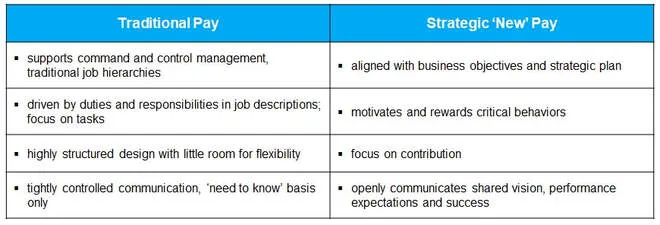
Common Reward Life-Cycle Stages:
Stage 1 - Start-Up
- Pay is managed by the Finance Director
- Pay is perceived as an overhead cost to be controlled
- No Pay Scales: There is simply ‘spot’ pay levels for everyone
- No formal job evaluation
- Performance rewards are discretionary
- Links between skill and competency acquisition and reward are unexplored
Stage 2 - Maturity
- Remuneration levels are set based on systematic monitoring of market data
- Competitive benefits of which the core is harmonized among employees
- Job evaluations are managed by use of formal approach
- Performance rewards are underpinned by formal approach
- Flexible approaches to Reward Management to support organization’s strategic objectives
- Good communication on reward issues with the employees
- A sensible balance is struck between central and devolved control overpay decisions, emphasizing line management involvement in and ownership of remuneration policy
Stage 3 - Old Age
- Rigid pay structures are typically based on length of service
- Rigidity and over emphasis on status and hierarchy in benefits and entitlement
- Long-established, bureaucratic, and often outdated approaches to job evaluation reflect old organizational values in design, application and hierarchies requiring an army of specialists to maintain
- Performance Management are regarded as dishonest annual rituals
- Market monitoring is over-systematized and often very costly
- Policy development is over centralized
Stage 4 - Renewal
- Policy is decentralized and devoted down to individual business units
- Old pay structures, incentive schemes and progression systems are abandoned as too costly and too complex to administer
- Broad banded pay structure is introduced to match a delayered organization
- Benefit policy is revised, eliminating all superfluous items and allowances in favor of ‘clean cash’ and move towards flexible benefits
- Competence-based or Team-based pay is introduced, and performance awards are paid only for demonstrable added value
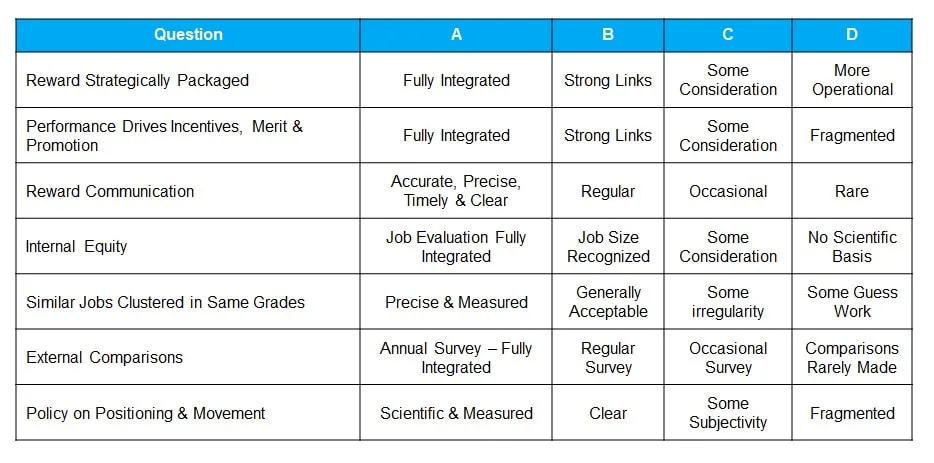
Reward Audit
Answer and score the questions for your organization.
Score: A=12 B=8 C=4 D=0
Organization Reward Audit
Emotional Reward is more than ‘Just Pay’
We need to remember that reward has an ‘emotional dimension’
Tangibles
- physical environment
- sustainability of work
- work facilities
- security
Quality of Work
- perception of the value of work
- achievement
- challenge
- recognition
- work interest
Lifestyle
- social environment
- life-style balance
- caring environment
Work Style
- working relationships
- risk sharing
- freedom & autonomy
- pace of work
Building for the Future
- career advancement
- learning & development
- performance improvement & feedback
6 Guiding Principles
1. Think strategically about reward
- Consider how to best position your organization relative to the competition
- Be clear that ‘internal equity’ and ‘external competitiveness’ are key drivers
- Communicate, communicate and then communicate some more
2. Invest heavily in a ‘Pay for Performance’ culture
- Ensure performance management works - clear targets, well planned, continuous management, fair review, no surprises
- Be aggressive on incentive payments and ensure you are ‘sharing in success’
3. Check the market and be transparent on findings
- Rumors always ‘run wide’ of the market
4. Policies, Procedures and Guidelines should eliminate unfair practices
- Be clear on how to position and move through the grade structure
- Are there times when the job grade could be different from the personal grade?
- Is the criteria for the annual review transparent?
5. Never under-estimate the power of recognition
- Payment is never enough, ensure that staff know their contribution is being measured and when appropriate is appreciated (Awards; Presentations; Articles; Certificates; - they all help)
6. Accept that your best performing staff will always want more pay
- It is their way of telling you that the value they deliver exceeds the compensation they receive